Roman telescope is in space: the checks and journey before its first science images

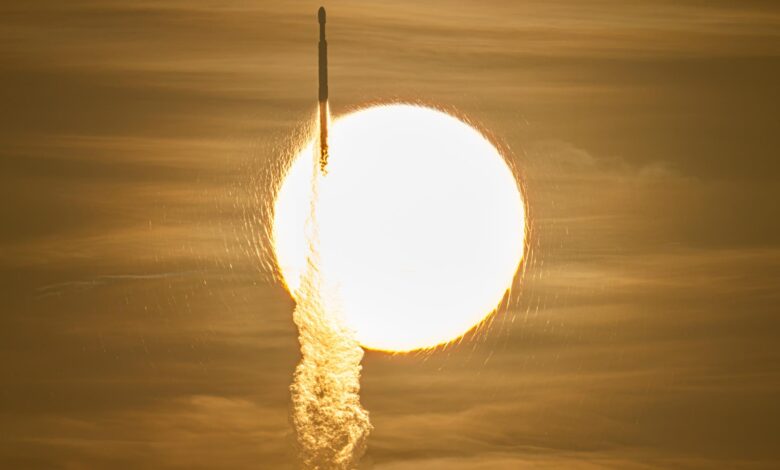
August 31 — NASA’s Nancy Grace Roman Space Telescope is on its way to its operating region after launching from Florida on Sunday. The next phase is not an immediate stream of discoveries: controllers must complete deployments, guide the observatory toward Sun–Earth L2 and test the instruments before routine science can begin.
A Falcon Heavy lifted off from Kennedy Space Center’s Launch Complex 39A at 7:26 a.m. EDT on August 30, equivalent to 4:56 p.m. in India. The mission’s launch update confirmed telemetry reception seven minutes later and spacecraft separation 31 minutes after liftoff.
What has been completed
Separation means the telescope is flying independently of the launch vehicle. The launch release also confirmed deployment of its solar panels and lower instrument sunshade one hour and 23 minutes after liftoff.
Those are important engineering milestones, but they are not evidence that the scientific instruments are fully calibrated or that Roman has reached its final orbit.
What comes next
The release set out further deployments, course corrections and instrument activation during the journey. A roughly three-month commissioning programme includes testing and calibration, with first images anticipated in early 2027. That is an expectation, not a guarantee of an exact release date.
Roman’s destination is the Sun–Earth L2 region, about a million miles from Earth. The mission’s technical specification gives a five-year duration with a ten-year goal; the longer figure is an objective, not an already secured extension.
Why the hardware matters
The observatory has a 2.4-metre primary mirror and two main instruments: the Wide Field Instrument and the Coronagraph Instrument. The former supports wide-area observations; the latter is a technology demonstration for suppressing a star’s glare so much fainter nearby objects can be studied.
Roman’s planned investigations include dark energy, dark matter and planets outside the solar system. Successful launch allows that programme to move forward, but none of those scientific questions was answered simply by putting the spacecraft in flight.
The useful milestones to watch are confirmed deployments, instrument checkout results, arrival at the operating orbit and the release of calibrated observations. A genuine launch photograph shows an accomplished event; an illustration of Roman in deep space, by contrast, would still be an illustration—not a camera view from its destination.
Current-event photograph: a Falcon Heavy carrying the Nancy Grace Roman Space Telescope appears against the Sun during launch from Kennedy Space Center, 30 August 2026. Photo: NASA/John Kraus, NASA launch release; used editorially under NASA media-use guidelines.