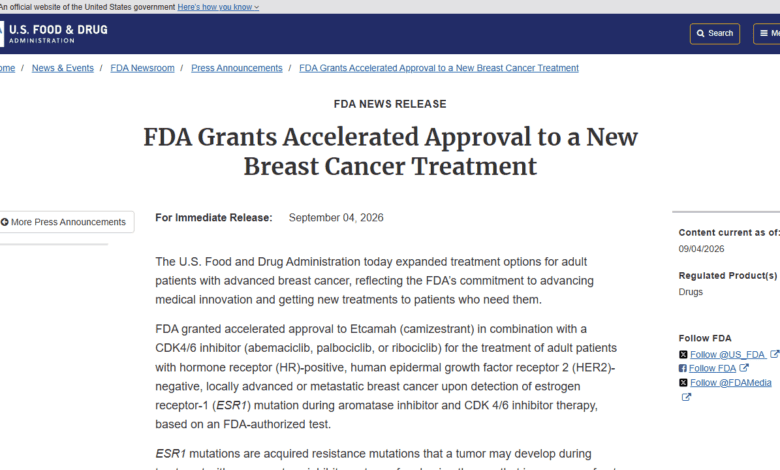
The US Food and Drug Administration has granted accelerated approval to Etcamah, or camizestrant, in combination with a CDK4/6 inhibitor for a defined group of adults with advanced breast cancer.
The approval covers hormone-receptor-positive, HER2-negative locally advanced or metastatic disease when an ESR1 resistance mutation is detected during treatment with an aromatase inhibitor plus a CDK4/6 inhibitor. The mutation must be found with an FDA-authorised test.
A blood test can trigger an earlier switch
ESR1 mutations can emerge as a tumour develops resistance to endocrine treatment. The FDA says fewer than 5% of patients have the mutation when HR-positive metastatic breast cancer is first diagnosed, but nearly 40% have it after progression on an aromatase inhibitor.
The agency also authorised Guardant360 CDx as a companion diagnostic. It detects fragments of circulating tumour DNA in blood, allowing clinicians to identify the resistance mutation before conventional imaging necessarily shows that the cancer has progressed.
In the trial described by FDA, estimated median progression-free survival was 16 months for patients switched to Etcamah plus a CDK4/6 inhibitor, compared with 9.2 months for those continuing an aromatase inhibitor plus a CDK4/6 inhibitor.
Why “accelerated” approval needs a caveat
The decision is based on an intermediate endpoint. FDA explicitly says it is not yet confirmed that switching at molecular detection, instead of waiting for radiographic progression, produces a clinically meaningful benefit such as longer overall survival or better quality of life. Confirmatory studies are required to verify and describe the benefit.
The prescribing information carries a boxed warning about irregular heart rhythm when Etcamah is combined with certain medicines. It also warns about abnormally slow heart rate and possible harm to an unborn baby. Treatment selection therefore belongs with an oncology team using the approved test and full prescribing information.
Who falls within the FDA indication
This approval is deliberately narrow. It applies to adults whose cancer is HR-positive and HER2-negative, is locally advanced or metastatic, and develops an ESR1 mutation while the patient is already receiving an aromatase inhibitor with a CDK4/6 inhibitor. The FDA-authorised test is part of that treatment pathway; the announcement is not a recommendation to use camizestrant for every case of breast cancer or for a tumour without the specified mutation.
The combination also matters. FDA lists abemaciclib, palbociclib and ribociclib as the CDK4/6 inhibitor options used with Etcamah. The decision is therefore about switching the endocrine component after molecular evidence of resistance while continuing an appropriate CDK4/6 inhibitor, rather than treating the oral tablet as a stand-alone medicine.
How to read the trial number
Median progression-free survival describes the point at which half the people in a trial group had experienced disease progression or death and half had not. It does not predict how long a particular patient will respond. Differences in previous treatment, other illnesses, tumour biology and adverse effects can all affect an individual course.
The accelerated pathway gives eligible patients earlier access while leaving an important evidence question open. FDA has required confirmatory work because detecting resistance in blood before it appears on imaging is promising, but earlier molecular action still has to demonstrate a meaningful clinical benefit. Patients should discuss eligibility, heart-rhythm risks, pregnancy precautions and medicine interactions with their oncology team rather than changing treatment from a news report.
Sources: FDA approval announcement, trial results and warnings; FDA advisory-committee briefing material.
FDA announcement of the Etcamah accelerated approval. Screenshot: US Food and Drug Administration.