Nepal seeks climate compensation from China, US and India after Rasuwa flood: what is confirmed

Nepal’s foreign minister has called for the country’s response to the catastrophic Rasuwa flood to move beyond conventional aid and towards climate justice, while naming China, the United States and India as major emitters from which vulnerable countries should seek compensation.
The demand is a significant diplomatic signal, but its status needs careful explanation. ThePrint reported that Foreign Minister Shishir Khanal made the remarks in an interview with Kantipur TV and said Nepal’s Finance Ministry had sent a climate-compensation claim letter to international partners. As of September 2, the publicly available flood briefings on Nepal’s Ministry of Foreign Affairs website do not reproduce that letter, identify its recipients or specify a sum demanded from any country.
The distinction matters: a minister’s announced diplomatic position is news, but it is not yet evidence that China, the US or India has accepted responsibility, received an assessed bill or agreed to pay Nepal.
What Khanal’s reported demand says
According to ThePrint’s account of the interview, Khanal argued that Nepal contributes very little to the greenhouse-gas problem but is absorbing extreme human and economic losses. He described the issue as one of justice and responsibility rather than charity, and named the world’s three largest current national emitters—China, the United States and India.
A separate Kantipur TV report published Wednesday confirms the broader policy direction. It says Prime Minister Balen Shah told Parliament that Nepal must present the climate impacts it faces more forcefully to the international community, while Khanal said Nepal would raise climate justice firmly and clearly. The report discusses the United Nations General Assembly as a possible platform, but does not publish a country-by-country compensation calculation.
The disaster and the recovery bill
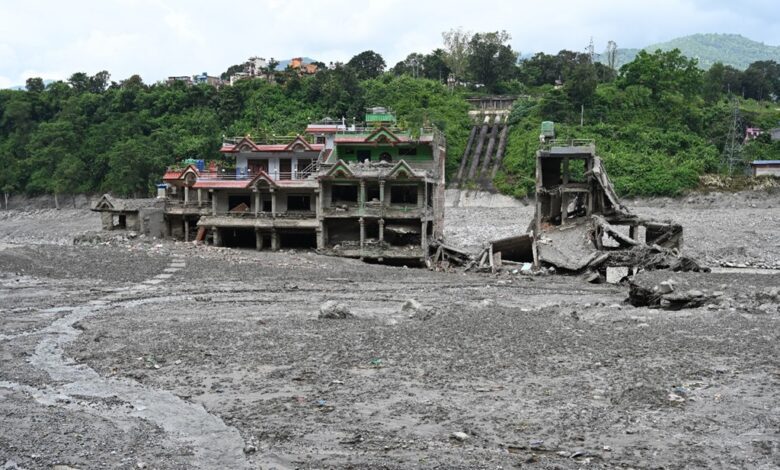
The August 26 flood devastated settlements and infrastructure along the Bhote Koshi–Trishuli river system. In its September 2 briefing, Nepal’s foreign ministry said 1,114 bodies had been recovered, about 3,900 people remained missing and 11,993 people had been rescued. The ministry warned that the figures were still changing as search and verification continued.
The World Health Organization says severe flooding affected the Bhote Koshi and Trishuli corridors across Rasuwa, Nuwakot, Dhading, Chitwan, Gorkha and Tanahun. It reported that around 10,000 households needed immediate relief, while health posts, hospitals, roads, bridges, markets and water systems had been damaged.
The physical cause is also still being assessed. WHO says preliminary information points to a sudden surge from the Tibet Autonomous Region, possibly linked to an upstream ice avalanche and temporary damming of the Lhende River. That is not the same as evidence that a man-made Chinese dam ruptured.
Finance Minister Swarnim Wagle has estimated that reconstruction and rehabilitation could require US$4 billion to US$5 billion. Officials have stressed that this is preliminary. A full post-disaster needs assessment will measure damage to homes, livelihoods, hydropower, roads and public services before Nepal finalises its recovery requirement.
Why the choice of countries is politically sensitive
China, the United States and India were the three largest national greenhouse-gas emitters in 2024, according to the European Commission’s EDGAR database. It estimated their shares of that year’s global emissions at 29.2%, 11.1% and 8.2%, respectively.
Annual emissions are only one measure of responsibility. Cumulative emissions, per-person emissions, consumption-based emissions, national income and ability to pay all produce different comparisons. Data based on the Global Carbon Budget show that the United States has emitted far more fossil carbon dioxide cumulatively than either China or India, while India’s historical share remains much lower than its present annual ranking.
That makes a simple formula based only on today’s ranking difficult to defend. A credible compensation proposal would need a transparent method for separating the effect of human-caused warming from the region’s natural geological hazards, attributing shares among emitters and valuing economic as well as non-economic losses.
Climate compensation already has a UN route
The debate is not starting from zero. Countries created the Fund for Responding to Loss and Damage under the UN climate process to help particularly vulnerable developing countries respond to climate-related economic and non-economic harm. Its initial Barbados Implementation Modalities set aside US$250 million for 2025–2026 interventions.
The fund supports country-led requests and offers direct-government and accredited-entity access routes. It is a financing mechanism, not an international court ruling that any particular state legally caused a particular flood. Nepal could therefore pursue multilateral loss-and-damage finance, bilateral support and a political campaign for larger contributions at the same time.
Nepal’s own NDC 3.0 climate plan already identifies floods, landslides, glacial-lake outburst floods, droughts, wildfires and glacier loss as forms of climate-related loss and damage. It also calls for collective global action while documenting the country’s substantial recovery and adaptation needs.
Aid and compensation are currently moving on separate tracks
Even as the compensation debate grows, the immediate response remains international and cooperative. Nepal’s September 2 briefing said specialist tunnel-rescue teams from India, China and South Korea were working with Nepali teams. Indian and Chinese forensic specialists were assisting identification work, and a Singaporean team had arrived with further personnel and equipment.
The ministry publicly thanked neighbours, partner countries and international organisations. That does not cancel Nepal’s climate-justice argument: emergency assistance addresses immediate survival, while loss-and-damage finance concerns recovery and the distribution of long-term costs. But it does show why headlines suggesting an already-settled diplomatic confrontation go beyond the public record.
What would confirm the compensation claim
Four developments would turn the present political declaration into a measurable process:
- publication of the reported Finance Ministry letter and the governments or institutions to which it was addressed;
- completion of Nepal’s post-disaster needs assessment;
- a scientific attribution study estimating how climate change altered the probability or severity of the flood; and
- formal responses from China, the United States, India or the UN loss-and-damage fund.
Until then, the verified conclusion is narrower than the most dramatic headlines: Nepal’s senior leaders are elevating the Rasuwa catastrophe into a campaign for climate justice, and Khanal has reportedly advocated compensation from major emitters. The financial amount, legal basis, recipients of any formal claim and responses from the named countries remain unconfirmed in the public documents reviewed.
Sources: ThePrint; Nepal Ministry of Foreign Affairs; Kantipur TV; WHO Nepal; The Kathmandu Post; EDGAR; Global Carbon Budget data; UNFCCC.
Flood-damaged buildings in Nepal after the 2026 Rasuwa disaster. Image: WHO Nepal.