Brain-Computer Interface Lets an Avatar Speak and Gesture at the Same Time—But It Is Not a Treatment Yet

A research team at the University of California, San Francisco has demonstrated a brain-computer interface that can turn signals associated with attempted speech and upper-body gestures into a digital avatar’s expression at the same time.
The result, announced by the US National Institutes of Health on September 14, is a notable step toward more natural communication for some people with severe paralysis. It is also an early proof of concept, not a treatment that people can obtain today.
The NIH-funded study involved three participants with different degrees of vocal-tract and bodily paralysis. Researchers used implanted electrocorticography, or ECoG, arrays placed on the motor cortex to record neural activity. They collected data while participants attempted to say selected phrases, make familiar gestures such as a wave or thumbs-up, and combine speech with gestures.
In real time, the system translated the signals of two participants into commands for personalised full-body virtual avatars. The avatars could produce speech and upper-body gestures together. The study, Simultaneous speech and gesture decoding for multimodal communication in paralysis, was published in Nature Neuroscience.
Why pairing speech and gesture matters
Human communication is not a stream of words alone. A nod can signal agreement, a raised hand can indicate a turn to speak, and facial or bodily movement can change the meaning of identical words. People who lose reliable speech and movement after conditions such as amyotrophic lateral sclerosis or a brainstem stroke can therefore face a loss that is broader than typing speed.
Existing assistive tools can be life-changing. Eye-tracking systems, for example, can allow a person to select text that is spoken aloud by a computer. But the NIH notes that this approach can be slow, limited in expressive range and tiring to use for some patients. The new research asked whether a BCI could represent two natural channels of expression at once rather than treating speech and gesture as entirely separate tasks.
That question is scientifically important. The researchers found that neural patterns recorded during simultaneous speech and gesture were not simply the two individual patterns added together. Decoders trained with simultaneous-expression data performed better at interpreting those mixed signals than systems trained only on separate speech and separate gesture tasks.
The finding does not mean a computer can read every private thought. The device was trained on specific attempted expressions from individual participants, with electrodes recording from a defined part of the brain. It produced a limited set of digital outputs within a carefully designed research setting. That is very different from unrestricted access to a person’s inner life.
A milestone with clear limits
The study is encouraging precisely because the authors and the NIH describe its boundaries. It included three people, and only two participants used the system in real time to control an avatar. A small study can establish feasibility and reveal important design questions, but it cannot tell us how reliably the system will work across a large, diverse population or over years of daily use.
The present arrangement was also wired: implanted sensors connected to external processing units. That matters for mobility, comfort, maintenance and long-term practicality. Edward Chang, the UCSF neurosurgeon who led the work, told the NIH that the team plans to test a fully implantable wireless version. Testing is not the same as availability, regulatory authorisation, insurance coverage or evidence of a durable clinical benefit.
A virtual avatar is another important limitation and strength. It offers a controllable way to express speech and gesture, without claiming to restore a person’s physical movement. For a user, a more expressive avatar could still be meaningful: it may make remote conversation, care interactions or everyday social exchanges feel less constrained. But the study did not show that the interface reverses paralysis or cures the condition that caused it.
The path from laboratory demonstration to care
Translation will require more than improving an algorithm. Researchers will need to study surgical safety, device durability, comfort, calibration time, accuracy in noisy real-world settings and whether users can depend on the system without exhausting training sessions. They will also need to evaluate who benefits, who is excluded and how failures should be communicated during a conversation.
Privacy deserves special attention. Neural data are highly sensitive, even when a system is designed to decode only attempted speech or gestures. Future clinical systems will need clear consent processes, strong security and understandable controls over storage, processing and sharing. Accessibility also has a financial dimension: an advance available only to a small number of well-funded research participants would not by itself solve the communication barriers faced by many disabled people.
None of those challenges diminishes the present achievement. The study shows that simultaneous digital speech and gesture can be decoded from brain activity in a small group of people with paralysis. It offers evidence that a more complete model of communication may be technically possible.
The responsible way to describe the result is neither to dismiss it nor to overpromise. It is a research milestone that could guide future assistive technology. It is not a consumer device, a substitute for existing care or proof that BCIs can restore natural conversation for everyone with paralysis. The next studies—especially larger, longer and more independent ones—will determine how far this promising approach can travel from an avatar in a laboratory to dependable communication in daily life.
Sources
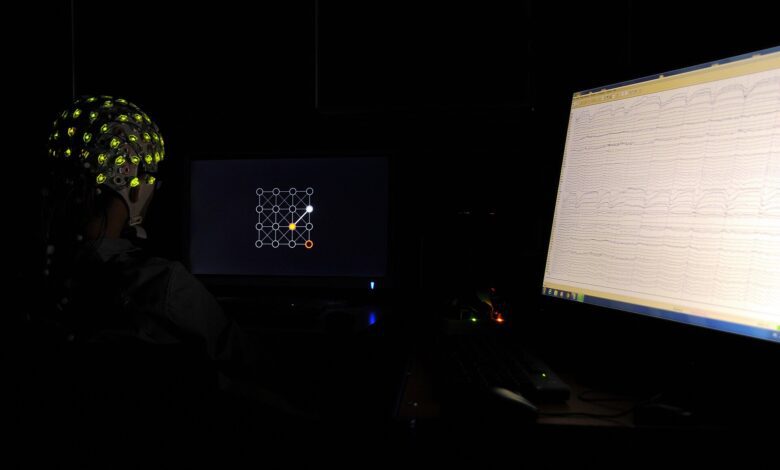
Featured image: NIH rehabilitation-research photograph, NIH, public domain. Representative image of an EEG-cap participant; it is not a participant in the UCSF study and does not show its implanted ECoG system.