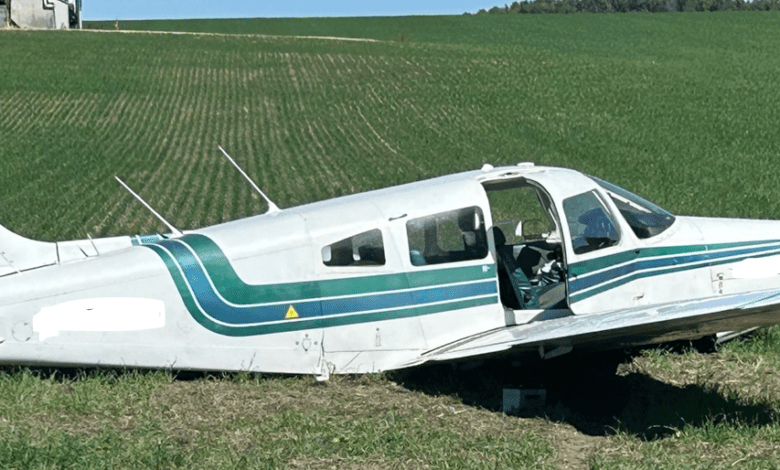
A 68-year-old pilot suffered minor injuries after a small aircraft crossed a road and came down in a farm field in Huron East, Ontario, in October 2024. Initial reports of additional passengers proved incorrect: they were people who had stopped to help.
The aircraft overshot a grass runway
Ontario Provincial Police said emergency services were called shortly after 11:20 a.m. on Saturday, October 5, near Newry Road. The location is in Huron County, northwest of Kitchener.
According to police, the Central Huron pilot attempted to land on a grass runway but could not stop before crossing Newry Road and striking the ground on the other side. The aircraft finished in an agricultural field.
The pilot went to hospital
Police described the pilot’s injuries as minor and said he was transported for treatment. No passenger injury was reported.
Emergency responders initially believed three other people had been aboard. Police later clarified that the individuals seen at the scene were Good Samaritans who stopped after the crash and helped the pilot. The force thanked them for their assistance.
Early information can change
Crash scenes are confusing: callers may see people beside an aircraft without knowing where they came from. First reports are useful for sending enough ambulances and firefighters, but they should not be repeated as confirmed passenger counts.
The correction is part of the story, not an embarrassing detail to hide. It shows why authorities verify identities and why readers should treat early breaking-news figures as provisional.
“Unable to stop” did not establish a cause
The police description explained the visible sequence but did not determine why the landing roll continued. Runway length and condition, speed, wind, mechanical performance, pilot decisions and aircraft configuration are among the factors an aviation investigation may examine.
It would be speculative to select one without technical evidence. Minor injuries likewise do not mean the event was minor from a safety perspective, because crossing an open road created risk to the pilot and other road users.
Grass-runway operations require margins
Unpaved surfaces can change with rain, temperature, vegetation and maintenance. Aircraft performance calculations account for surface type, slope, wind, weight and obstacles, while a pilot also needs a point at which to abandon an unstable approach.
Those are general safety principles, not findings about this pilot. Only investigators with records, wreckage access, weather data and witness accounts could apply them to the occurrence.
Who investigates Canadian accidents
Police secure a scene and address immediate public safety. The Transportation Safety Board of Canada is the independent agency responsible for advancing transportation safety when it investigates an aviation occurrence; its role is not to assign civil or criminal liability.
Not every accident receives the same level of investigation. The board considers the safety value of examining an event and may collect data without issuing a full public report.
The useful lesson is disciplined reporting
The verified facts were concise: one pilot, a runway overrun, a road crossing, a farm-field impact and minor injuries. The people first mistaken for passengers were helpers.
A responsible account preserves those facts while resisting a dramatic invented cause. Aviation safety improves through evidence—aircraft examination, performance data and operational context—not through assumptions drawn from a photograph of a damaged plane.