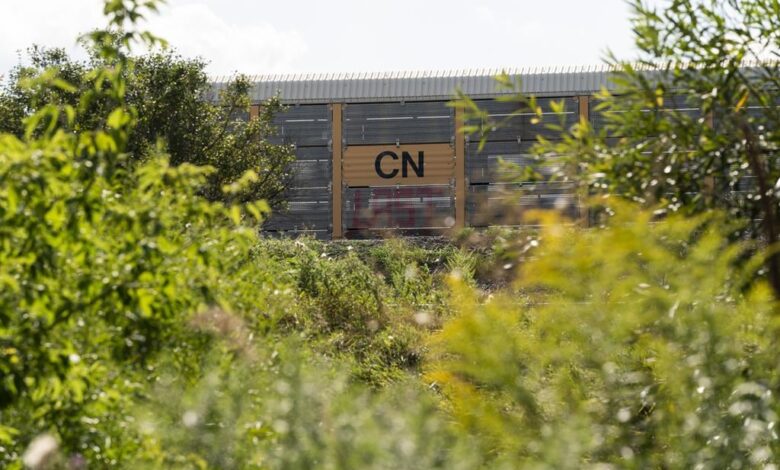
The Federal Court of Appeal ruled in October 2024 that federal approval of Canadian National Railway’s proposed Milton Logistics Hub was reasonable, allowing the project to proceed. The decision reversed a lower-court ruling but did not erase findings that the development was likely to cause significant adverse effects on air quality and human health.
The project transfers containers
CN proposed a roughly $250-million intermodal terminal in south Milton where containers would move between trains and trucks. Plans contemplated four trains a day and substantial truck traffic near Britannia and Tremaine roads.
CN argued that rail can replace longer-distance truck journeys, reduce highway congestion and serve growing freight demand in the Greater Toronto and Hamilton Area. Local governments and residents focused on diesel exhaust, road traffic, noise and proximity to planned communities.
A review panel found serious effects
A federal environmental review panel concluded in 2020 that the hub was likely to cause significant adverse effects on air quality and human health. Federal cabinet nevertheless approved the project in 2021 subject to hundreds of conditions.
Approval despite significant effects is possible under the governing assessment law when cabinet determines that effects are justified in the circumstances. That political judgment does not mean the effects were found harmless.
The lower court found the reasoning deficient
In March 2024, the Federal Court set aside the ministerial referral and cabinet justification decisions. It found the approval reasoning had not adequately fulfilled the duty to address human health.
CN and the federal government appealed. A stay allowed construction activity to continue while the appellate court considered the case.
The appeal restored federal approval
On October 4, a three-judge Federal Court of Appeal panel allowed the appeals. It concluded that the decision, read with the full record and conditions, met the legal standard of reasonableness.
Judicial review asks whether an administrative decision was lawful and reasonably justified. It does not ask judges to choose their preferred location or decide whether the project is good policy.
Parallel cases addressed different powers
Halton municipalities also challenged Canadian Transportation Agency railway approval and argued that provincial and municipal planning rules should apply. Courts recognized the federal core of railway location, construction and operation while leaving some generally applicable local rules intact where they do not impair that core.
Those proceedings should not be compressed into one “court approved the hub” claim. Each involved a different decision, statute and remedy.
Conditions now carry the accountability burden
Federal agencies oversee requirements involving air, water, noise, traffic, wildlife and reporting. Monitoring must use publicly understandable data, clear thresholds and enforceable corrective action if predictions prove wrong.
CN’s claim that rail reduces regional emissions can coexist with local diesel exposure from concentrated truck and train activity. Evaluation should measure both scales rather than using one to dismiss the other.
The legal fight ended, but oversight continued
By 2025, Halton reported that the court proceedings were at an end after the Supreme Court declined to hear a further appeal. The region continued monitoring implementation and seeking mitigation.
The 2024 ruling removed a major legal obstacle; it did not convert contested impacts into misinformation. The durable public-interest question became whether regulators and CN would meet every condition, publish credible measurements and protect neighbouring residents as the terminal was built and operated.