Nepal Flood Toll Reaches 579 as Search Lists Are Reconciled Across River Corridor

Nepal’s disaster-management authority raised the confirmed death toll from the Bhote Koshi and Trishuli flash floods to 579 on Friday evening, as search teams widened their work from the shattered Rasuwa border corridor to riverbanks far downstream.
The National Disaster Risk Reduction and Management Authority said 1,924 people remained unaccounted for and more than 3,700 had been rescued in Nepal. Those figures represent a later operational update than an earlier Nepal Police bulletin, which listed 2,381 people as out of contact and 1,545 rescues. The totals should not be added together: agencies were using different cut-off times and were still removing duplicate names, reconnecting people whose communications had failed, and adding workers from damaged hydropower and infrastructure sites.
Why the numbers are moving
Mobile, electricity and internet networks remain disrupted in parts of Rasuwa, Nuwakot and Dhading. A person can therefore appear on an out-of-contact list without being confirmed trapped or missing. At the same time, lists compiled by families, employers, tourism operators, local governments and security agencies may describe the same person differently. Officials have urged the public to treat each update as provisional while identity checks continue.
Bodies have been recovered along a long stretch of the river system, including in Chitwan and the two Nawalparasi districts, illustrating the force and distance of the surge. Identification is difficult where documents were lost or remains were carried far from the place where a person disappeared. Hospitals in the Kathmandu Valley are treating airlifted patients, while specialist teams continue recovery and forensic work.
Rescue effort expands
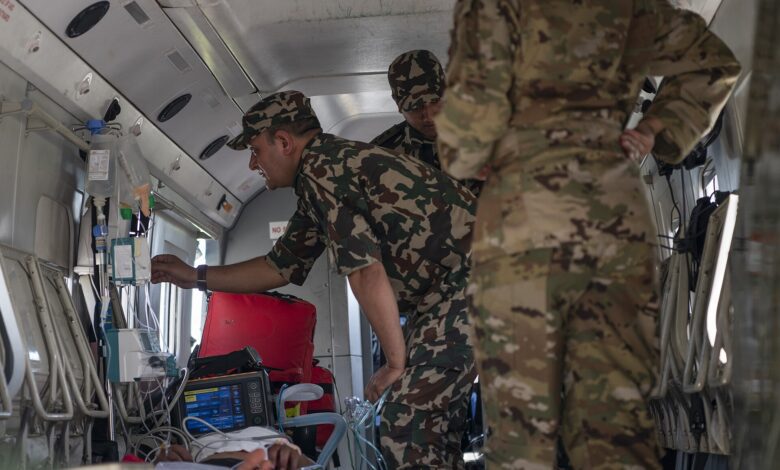
The government says roughly 14,800 security personnel have been mobilised. Helicopters, ground teams, drones and temporary communications equipment are being used to reach settlements cut off by destroyed roads and bridges. Earlier government figures said 351 people were flown out in 69 helicopter sorties on Thursday, with priority given to children, older people, pregnant and postpartum women, people with disabilities and the seriously injured.
Temporary accommodation has been arranged in schools and public buildings for about 3,500 people. Relief consignments include food, drinking water, tents, blankets, generators, medical supplies, batteries and portable mobile towers. Restoration teams are also assessing bridges, roads, electricity lines, drinking-water systems and telecommunications.
The out-of-contact lists include Nepali residents, security personnel, project workers, pilgrims and foreign visitors. Consular teams are checking names and locations, but nationality figures are also changing as contact is restored. The most reliable conclusion is that the disaster remains an active search-and-rescue emergency, not a settled casualty count. Families should rely on the latest official lists and emergency channels rather than circulating unverified names or images.