Quad Manila Summit Sets Maritime, Cable and AI Agenda for 2027

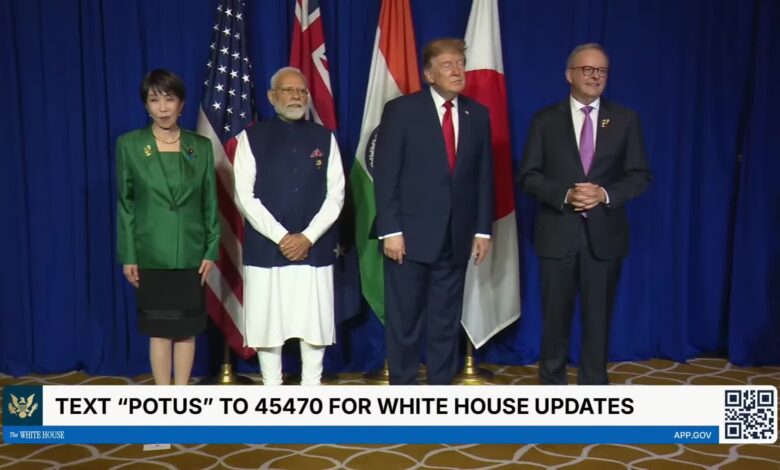
Four Indo-Pacific leaders left Manila on November 17 with a longer list of practical projects than the familiar diplomatic shorthand around the Quad might suggest. US President Donald Trump, Indian Prime Minister Narendra Modi, Australian Prime Minister Anthony Albanese and Japanese Prime Minister Sanae Takaichi used their first leaders’ meeting of this cycle to announce work on maritime surveillance, undersea cables, cyber security, artificial intelligence and private-sector investment.
The meeting matters because it placed India, Japan and Australia alongside the United States at a moment when Washington’s relationship with Beijing is again being tested by trade rules, advanced-computing controls and security tensions. Yet the joint statement is best read as a programme of intended cooperation, not a treaty alliance or evidence that every project is already financed. The Quad has no collective-defence clause, permanent secretariat or pooled military command.
What the four governments announced
The most concrete security initiative is the Indo-Pacific Maritime Surveillance Collaboration. The leaders said P-8 and P-3C patrol aircraft from the four countries are scheduled to fly together in a Quad context in 2027. These aircraft can monitor large areas of ocean, track ships and support search, rescue and disaster response. The statement does not describe a standing patrol force, and operational details—including locations and data-sharing rules—remain to be worked out.
The governments also expanded cooperation on communications and energy links. Their Partnership for Cable Connectivity and Resilience is intended to support secure undersea cables, while Australia plans to extend its contribution to electricity cables. For island and coastal economies, cable breaks can interrupt banking, government services and ordinary communications. Building alternative routes and faster repair capacity can therefore be both an economic and a national-security investment.
A new Quad Business Leaders’ Forum is scheduled for early 2027. Its stated purpose is to bring companies, officials and policy specialists together and encourage commercial deals. That wording is important: a forum can create introductions and project pipelines, but it does not guarantee contracts. Investors will still examine financing, local regulation, environmental safeguards and whether a proposal has real customers.
AI cooperation—and an unusual terminology note
The statement supports a technology accelerator designed to coordinate funding, access and technical assistance for trusted artificial-intelligence systems across the region. The White House document uses the phrase “Super Intelligence” and includes a footnote saying Australia, India and Japan refer to the same work as artificial intelligence. That difference in terminology does not by itself indicate that a new class of technology has been created.
For developing economies, access to computing infrastructure and skills can matter as much as headline model releases. Useful cooperation could include disaster forecasting, health systems, agriculture and language technology. It also raises questions about procurement, data protection, energy consumption and dependence on a small number of vendors. The value of the accelerator will be measurable only when its eligibility rules, funding and delivered projects are public.
China is central even when it is not named
The leaders opposed attempts to change the regional status quo through force or coercion and expressed concern about arbitrary export restrictions. They did not name China in those passages. The Quad’s language has often been deliberately broad, allowing members to defend principles without turning every initiative into a single-country bloc. All four have substantial economic interests in China, even as they differ with Beijing over maritime claims, borders, technology and trade.
The statement also reaffirmed support for ASEAN “centrality.” That is more than ceremonial language in Manila. Southeast Asian governments generally resist being forced to choose between major powers. Quad projects will gain credibility if local partners can shape them, publish their terms and show benefits beyond strategic competition.
Cybersecurity and terrorism
The leaders announced enhanced cybersecurity cooperation after acknowledging a rise in the scale and frequency of regional incidents. Joint exercises, standards and incident-response links can help, particularly where smaller governments lack specialist capacity. But cybersecurity partnerships also need clear rules for vulnerability disclosure, privacy and the sharing of sensitive data.
The four governments separately condemned terrorism and violent extremism, including cross-border terrorism. That language is particularly significant for India, which has long sought stronger international recognition of attacks and networks operating across national boundaries. The joint release did not announce a new sanctions list or enforcement mechanism.
What to watch next
Three tests will show whether Manila produced more than a polished communiqué. First, the 2027 aircraft activity should be accompanied by clear safety and transparency measures. Second, cable and infrastructure projects should move from announcements to funded, competitively procured work. Third, the AI and cyber initiatives should publish practical outcomes rather than count meetings.
The Quad’s attraction is its flexibility: it can coordinate without the legal machinery of a formal alliance. The same flexibility is also its weakness, because delivery depends on four governments maintaining attention through elections, budget disputes and changing crises. Manila set a detailed agenda. Its significance will be decided by what reaches the water, the network and the communities the partnership says it serves.
Sources
- Quad Leaders’ Summit joint press release, November 17, 2026
- Associated Press background on the Asia trip and APEC agenda