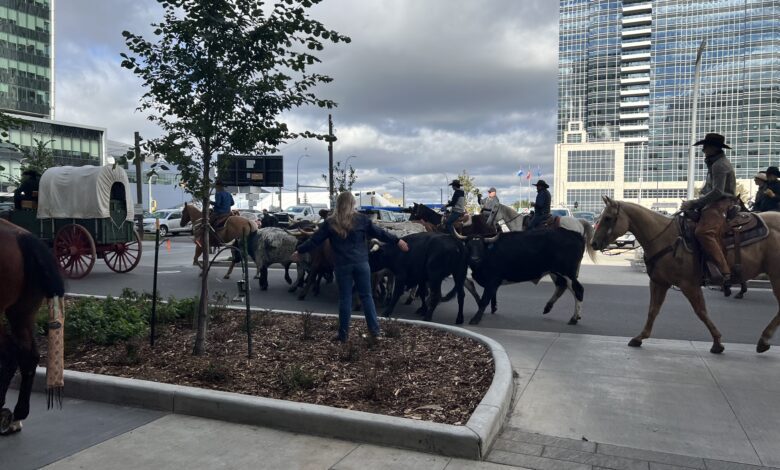
A downtown cattle drive opened the Canadian Finals Rodeo’s return to Edmonton on October 2, 2024. Ranchers and rodeo participants guided cattle from Sir Winston Churchill Square toward the Rogers Place Fan Park as spectators lined the route.
The procession brought the event into the city
The short drive used a controlled downtown route rather than recreating a long-distance ranch movement. Riders, livestock handlers and event personnel kept the herd together while traffic and pedestrian measures separated spectators.
For people working nearby, the scene replaced an ordinary city morning with horses, cattle and western clothing. It also gave the rodeo a public launch outside the ticketed arena.
Edmonton was the rodeo’s original home
The Canadian Finals Rodeo began in Edmonton in 1974 and remained there through 2017. It moved to Red Deer after the closure of the Northlands Coliseum ended its long-standing venue arrangement.
The 2024 edition marked a return after six years away. Holding competition at Rogers Place brought the championship into the downtown entertainment district instead of its former exhibition-grounds setting.
Competition ran from October 2 to 5
Leading Canadian professional rodeo athletes qualified across events including bareback and saddle-bronc riding, bull riding, tie-down roping, steer wrestling, barrel racing and team roping. Several performances over four days determined the year’s champions.
The Canadian Professional Rodeo Association listed more than $1.5 million in contestant payout for the 2024 finals. That scale made the return economically significant to competitors as well as symbolic for the host city.
The Fan Park widened access
Public programming around Rogers Place allowed residents to encounter western music, demonstrations, vendors and rodeo culture without every activity requiring an arena seat. Downtown businesses anticipated additional visitors during the event.
Economic-impact projections should be treated as estimates rather than cash automatically created. Visitor spending can benefit hotels, restaurants and transport, while public services and event support also carry costs.
Livestock welfare remained part of the discussion
Supporters describe professional rodeo as a skilled agricultural tradition with veterinary oversight and animal-care rules. Critics question whether timed and riding events expose animals to avoidable stress or injury.
Responsible coverage can report the celebration without dismissing that concern. Organizers and sanctioning bodies should publish welfare protocols, injury information and enforcement outcomes so audiences can evaluate practice rather than rely only on assurances.
A cattle drive requires preparation
Livestock can react to noise, crowds and unfamiliar surfaces. Experienced handlers, a planned route, barriers and contingency measures reduce risk to animals and the public.
Photographs capture the spectacle but not all the work behind it: transport, health checks, street cleaning, permits and coordination between event staff and municipal services.
The return tested a new venue model
Rogers Place was designed primarily for hockey and major entertainment, so rodeo production required specialized flooring, temporary configuration and movement plans for animals and equipment. The downtown location offered transit and hospitality advantages but less open space than a traditional fairground.
Attendance, competitor experience, animal care and neighbourhood impact would all matter when deciding whether the arrangement should continue.
The opening combined memory and reinvention
Older Edmonton spectators could remember decades of finals at Northlands, while younger residents encountered the event in a different part of the city. The drive deliberately connected those identities: working livestock and western sport moving through a modern urban centre.
The photographs documented a festive opening, not the entire rodeo or its controversies. The most complete account recognizes the homecoming, the professional championship that followed and the responsibility involved whenever animals, large crowds and city streets share the same public event.