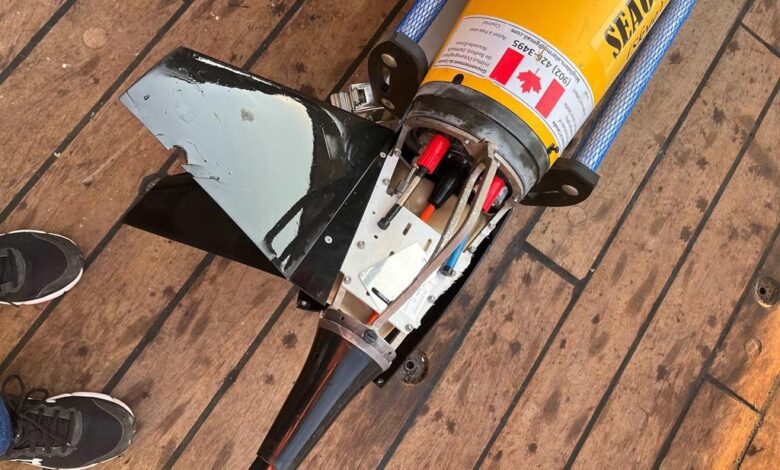
A Fisheries and Oceans Canada ocean glider returned from a mission off Nova Scotia in 2024 with deep gouges, two missing wings and a bent aluminum frame. Researchers concluded that a white shark was the most likely attacker, although nobody witnessed the bite directly.
The encounter occurred far below the surface
The glider was operating about 300 metres underwater when it was damaged. Research scientist Clark Richards said shark specialists who examined the marks were confident they came from a great white.
The depth made the encounter unusual because sunlight is limited and the bright yellow, torpedo-shaped device was not prey. A curious bite, mistaken identity or response to movement are possible explanations, but the evidence did not establish the animal’s motive.
A slow-moving robotic instrument
Ocean gliders travel without a conventional propeller. They pump oil into and out of a flexible bladder, changing buoyancy so the instrument rises and sinks while wings convert that vertical movement into forward travel.
The repeated dive pattern allows sensors to build profiles through the water column. Depending on the mission payload, scientists can measure properties such as temperature, salinity, oxygen and currents over longer periods than a ship can remain at one point.
Gliders communicate and transmit selected data when they surface. Their efficient movement makes them useful in remote or rough water, though fishing gear, ships, weather and animals still pose risks.
The damage showed substantial force
The bite removed two wings and left marks in plastic components. Richards said a solid aluminum section at the rear had been bent by roughly 45 degrees.
Crucially, the animal did not puncture the buoyancy bladder. The glider could continue cycling through the water, return to the surface and signal for recovery rather than sinking with its data.
Canadian scientists aboard a British research vessel retrieved the instrument. It had cost approximately $250,000 when purchased about eight years earlier, and the department expected to repair it.
Evidence, not a filmed attack
Calling the event a shark “attack” is an accessible description of the physical damage, not proof that a shark targeted scientific work aggressively. Identification rested on bite morphology, strength, location and expert assessment rather than video or a tagged individual.
That distinction matters because sensational accounts can portray normal animal investigation as deliberate hostility. White sharks use their mouths to examine objects in an environment where vision can be limited.
What engineers can learn
Researchers can compare bite locations with material, colour, acoustic output and electrical fields, then decide whether protective design is worthwhile. Stronger components add weight and may reduce mission endurance, so preventing every rare event may not be efficient.
Recovery planning is equally important. Redundant positioning, emergency surfacing, remote diagnostics and a nearby vessel can save both equipment and irreplaceable observations after damage.
A rare interaction with scientific value
The incident did not indicate that Nova Scotia waters had suddenly become unsafe for people. A glider operating 300 metres down has a different risk profile from a swimmer near shore, and one bite cannot establish a population trend.
Nor was the mission necessarily a failure. The device survived, was recovered and offered engineers an unusual record of how research hardware responds to a powerful marine animal.
The most accurate story is therefore both less dramatic and more interesting than a mechanical “victim” narrative: investigators inferred a white-shark bite from distinctive damage, the buoyancy system kept working, and an instrument built to observe the ocean returned with an unexpected observation written onto its own frame.